
Duct Air Leakage Testing Standards Explained: Why They Matter and How the DALT 6905 Simplifies Compliance
Sections Navigation
- What Is Duct Air Leakage Testing?
- Why Duct Leakage Testing Standards Matter
- Key Duct Air Leakage Testing Standards
- Why Duct Leakage Standards Are Not Always Equivalent
- Why Standards Matter in Real-World HVAC Work
- What to Confirm Before Testing
- How the DALT 6905 Simplifies Duct Leakage Testing
- Key Features of the DALT 6905
- Typical Duct Leakage Testing Procedure
- The Bigger Picture: Performance Verification
- Why This Topic Matters for HVAC Professionals
In commercial HVAC systems, ductwork is expected to do far more than simply move air from point A to point B. It must deliver air efficiently, consistently, and in full compliance with project specifications. However, even well-constructed duct systems can lose performance due to air leakage at seams, joints, access doors, and connections.
That is why duct air leakage testing is essential.
At its core, duct leakage testing measures how much air escapes from a duct system under pressure. In practice, however, it serves a much greater purpose: verifying system performance, ensuring compliance with industry standards, and providing measurable proof that ductwork meets required specifications.
What Is Duct Air Leakage Testing?

Duct air leakage testing is the process of pressurizing or depressurizing ductwork and measuring the amount of air that escapes. This allows HVAC professionals to:
- Validate duct sealing quality
- Ensure system efficiency
- Meet project specifications and compliance requirements
- Support commissioning and quality assurance
Without proper testing, air leakage can lead to energy waste, poor system performance, and failure to meet regulatory standards.
Why Duct Leakage Testing Standards Matter
One of the most common misconceptions is that duct leakage testing is simply a troubleshooting tool. While it can identify leaks, its primary role is to determine:
“Does the duct system meet the allowable leakage limits defined by the applicable standard?”
This distinction is critical.
Eliminating Subjectivity
Without standardized testing procedures, leakage becomes a matter of opinion. Standards provide:
- Defined test pressures
- Acceptable leakage limits
- Consistent measurement methods
- Clear pass/fail criteria
This transforms duct testing from guesswork into a repeatable, measurable process.
Ensuring Compliance Across Projects
Different projects, regions, and specifications require different standards. These standards directly influence:
- How tests are conducted
- How results are interpreted
- Whether a system is accepted or rejected
Key Duct Air Leakage Testing Standards
Duct leakage testing standards vary globally and by application. The most widely recognized include:
North American Standards

SMACNA
The Sheet Metal and Air Conditioning Contractors’ National Association, or SMACNA, provides one of the most widely recognized duct leakage frameworks in the United States.
SMACNA uses a leakage-class system based primarily on duct surface area and test pressure. The allowable leakage relationship is commonly expressed as:
F = CL × P0.65
Where:
- F is the allowable leakage in CFM per 100 square feet of duct surface area
- CL is the specified leakage class
- P is the test pressure in inches of water gauge
Under this method, allowable total leakage changes with the size of the tested duct section, the selected pressure, and the specified leakage class.
A larger duct section will generally have a higher total allowable leakage value than a smaller section tested under the same pressure and leakage class.
AABC
The Associated Air Balance Council, or AABC, approaches duct leakage from a testing, adjusting, and balancing perspective.
AABC requirements commonly express allowable leakage as a percentage of system airflow. The acceptable percentage and minimum test pressure may depend on the system type and project requirements.
This creates an important distinction:
- SMACNA is generally based on leakage class, duct area, and pressure.
- AABC commonly relates allowable leakage to system airflow.
When only part of a system is tested, the allowable leakage for that section may need to be calculated as a portion of the total system allowance.
European Standards

EN 12237
EN 12237 applies primarily to circular sheet-metal ducts used in ventilation and air-conditioning systems.
It addresses:
- Duct strength
- Air leakage
- Air-tightness classification
- Positive and negative pressure limits
- Testing requirements for circular ductwork
The standard commonly uses air-tightness classes such as A, B, C, and D. Higher classes represent tighter duct construction and lower permitted leakage.
EN 1507
EN 1507 applies primarily to rectangular sheet-metal ducts.
Like EN 12237, it addresses duct strength and leakage, but its requirements are specific to rectangular duct sections.
The standard considers:
- Air-tightness class
- Duct pressure class
- Test pressure
- Duct surface area
- Structural performance
Although EN 12237 and EN 1507 use similar terminology, they should not be treated as identical because they apply to different duct shapes.
DW/143
DW/143 is a practical ductwork air leakage testing guide commonly associated with the United Kingdom.
It provides field-oriented testing procedures and acceptance requirements for low-, medium-, and high-pressure duct systems.
DW/143 commonly considers:
- Duct pressure class
- Test pressure
- Duct surface area
- Allowable leakage rate
- Positive and negative pressure limits
- Test documentation
Its practical field focus makes it a common reference for contractors and testing professionals working on UK-based projects.

Eurovent 2/2
Eurovent 2/2 addresses air leakage rates in sheet-metal air-distribution systems.
It relates measured leakage to:
- Duct surface area
- Static test pressure
- Leakage classification
- Leakage rate per unit area
Although Eurovent results may sometimes be related to percentage air loss when system airflow is known, they should not automatically be treated as equivalent to AABC percentage-based limits.
Asian Standards
GB 50243
GB 50243 is a Chinese construction-quality acceptance standard for ventilation and air-conditioning work.
Its duct leakage requirements are structured around:
- Low-, medium-, and high-pressure systems
- Working pressure
- Duct surface area
- Duct material and construction
- Maximum allowable leakage
Rather than using the same A-through-D structure commonly associated with European standards, GB 50243 follows its own pressure-based acceptance framework.
Why Duct Leakage Standards Are Not Always Equivalent
Most duct leakage standards measure how much air escapes from or enters a sealed duct section while it is held at a specified test pressure.
The standards may differ in how they express the allowable result. Leakage may be based on:
- Duct surface area
- Test pressure
- Leakage or air-tightness class
- Percentage of total system airflow
- Duct type and construction
- Positive or negative pressure limits
Because the calculation methods differ, the same measured leakage rate may pass under one standard and fail under another.
The governing standard should therefore be identified before testing begins.
Why Standards Matter in Real-World HVAC Work
In the field, HVAC professionals need:
- Clear testing procedures
- Efficient setup workflows
- Reliable, defensible results
Standards provide that foundation, but the testing process can still be complex, especially for teams that do not perform leakage testing regularly.
This is where modern instrumentation plays a critical role.
What to Confirm Before Testing
Before beginning a duct leakage test, confirm the following information.
Governing Standard
Identify the exact standard required by the specification, engineer, code, or commissioning plan.
Duct Type
Determine whether the duct is circular, rectangular, metallic, nonmetallic, supply, return, or exhaust.
Test Pressure
Use the test pressure required by the project or applicable standard.
Leakage Class or Allowable Percentage
Confirm whether acceptance is based on a leakage class, air-tightness class, percentage of system airflow, or another limit.
Duct Surface Area
Surface area is required for standards that normalize leakage by the size of the tested duct section.
System Airflow
System airflow is particularly important when leakage is expressed as a percentage.
Reporting Units
Confirm whether results must be reported in CFM, CFM per square foot, liters per second per square meter, cubic meters per hour per square meter, or another unit.
Clarifying these details before testing helps prevent calculation errors, reporting issues, and disagreements over pass-or-fail results.
How the DALT 6905 Simplifies Duct Leakage Testing
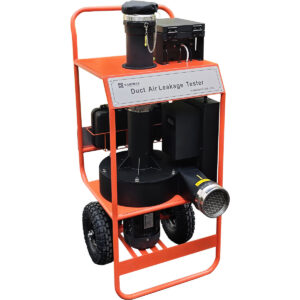
The Kanomax DALT 6905 Duct Air Leakage Tester is designed to streamline the entire testing process by integrating multiple standards directly into its workflow.
Built-In Standards for Global Flexibility
Instead of manually configuring test methods, users can select from built-in standards, including:
- SMACNA
- AABC
- EN 12237 / EN 1507
- DW/143
- Eurovent 2/2
- GB50243
This ensures accurate testing aligned with project requirements.
Guided Workflow for Ease of Use
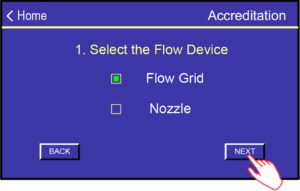
The DALT 6905 simplifies testing by guiding users through:
- Standard selection
- Nozzle selection
- Surface area input
- Test duration setup
- Pressure adjustment
This reduces setup errors and makes the process more accessible for both experienced professionals and newer technicians.
Key Features of the DALT 6905

*Refers to older model 6900, but key features of the 6905 are largely identical
- Wide measurement range:
- Large nozzle: 41–483 CFM
- Small nozzle: 2.4–41 CFM
- Pressure measurement: Up to ±10 in. w.g.
- Data storage: Up to 1,000 measurements
- Real-time monitoring: Leakage, pressure, temperature, atmospheric pressure
- Dual testing capability: Positive and negative pressure
- Compact, lightweight design: Optimized for field use
These features make the DALT 6905 both powerful and practical for on-site commercial HVAC testing.
Typical Duct Leakage Testing Procedure

A standard duct leakage test generally includes:
- Sealing all duct openings except the test connection
- Calculating duct surface area
- Connecting the leakage tester
- Selecting the appropriate standard and nozzle
- Entering test parameters (area, time, pressure)
- Pressurizing or depressurizing the system
- Measuring leakage rate
- Comparing results to allowable limits
- Saving and documenting results
Understanding this workflow helps demystify the process and reinforces the importance of standards.
The Bigger Picture: Performance Verification
Duct air leakage testing is ultimately about accountability and performance verification.
It enables HVAC professionals to:
- Confirm system efficiency
- Reduce energy loss
- Support commissioning and project acceptance
- Provide documented proof of compliance
While equipment and standards may evolve, the core objective remains the same:
Ensure the system performs as intended, and prove it.
Why This Topic Matters for HVAC Professionals
Duct leakage testing is a critical component of modern HVAC system validation. As efficiency standards tighten and project requirements become more demanding, having the right tools and understanding the standards behind them is essential.
The DALT 6905 aligns with this need by combining:
- Standards-based testing
- User-friendly workflows
- Reliable, repeatable results
For experienced professionals, it streamlines operations. For newer users, it provides clarity and confidence.
Duct air leakage testing is about ensuring HVAC systems meet performance expectations and regulatory standards.
By combining standardized testing methods with advanced instrumentation like the DALT 6905, HVAC professionals can:
- Improve system efficiency
- Reduce costly rework
- Deliver measurable, verifiable results
Most importantly, they can ensure that every system performs exactly as intended.


